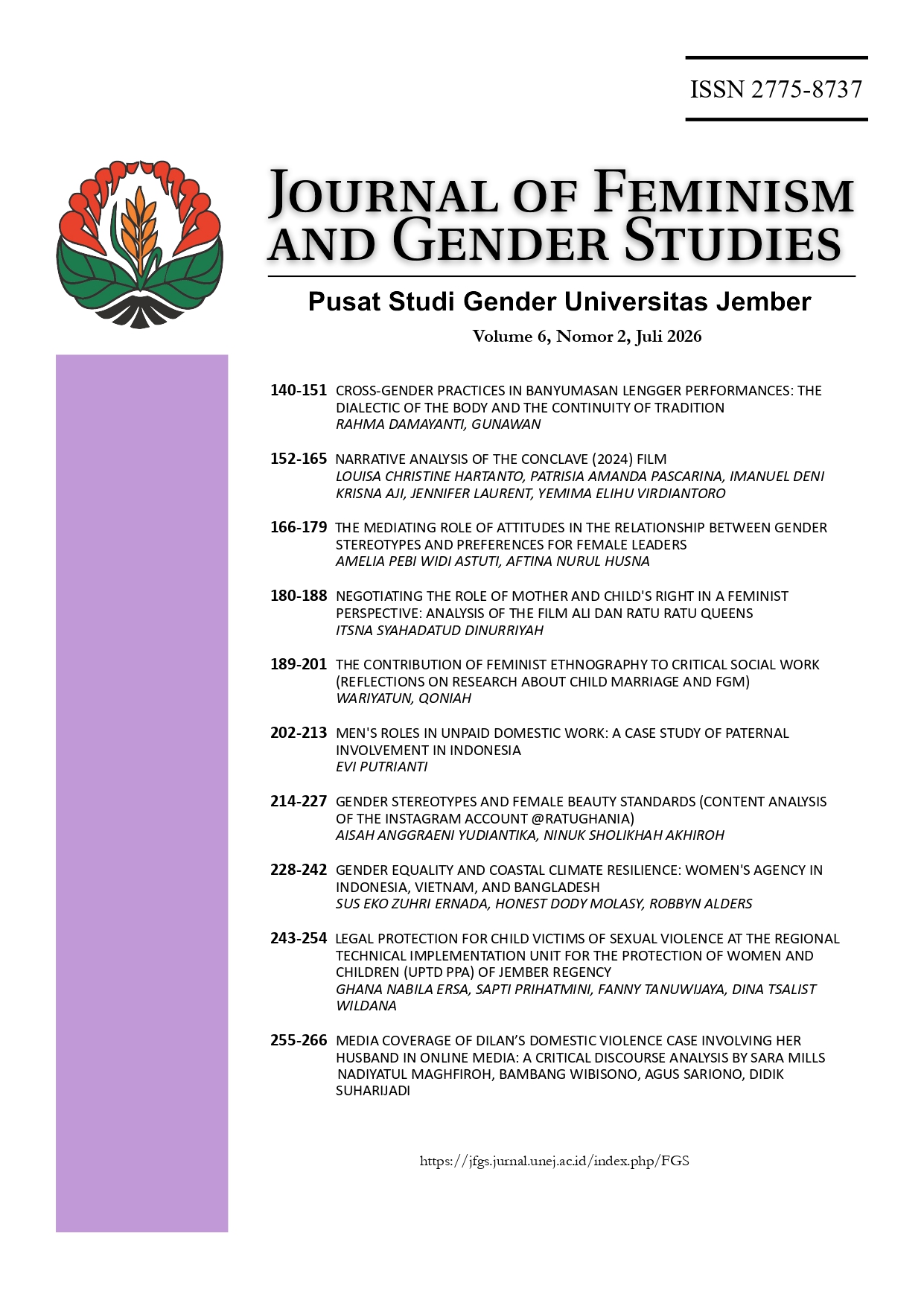
Narrative Analysis of the Conclave (2024) Film
DOI:
https://doi.org/10.19184/jfgs.v6i2.53720Keywords:
lgbtq+, catholic church, narrative, film studies, gender identityAbstract
The emergence of a new gender group categorized by the acronym LGBTQ+ in society has caused debate. The expressions they show in everyday life divide the opinions of various parties, one of which is the Catholic Church. This study aims to dissect the narrative in the film "Conclave" (2024) which shows the conflicting views of the bishops when choosing a new Pope in the Conclave session. The conflict between conservative and liberal bishops leads them to the fact that the elected Pope turns out to have a condition called intersex. In order to dissect the confession of the Catholic Church in the film, this study uses Todorov's narrative analysis method which states that the complexity of a narrative is structured based on the level of story and level of plot. Although this film does not directly tell that the bishops participating in the conclave accept the LGBTQ+ group as members of the church, at the end of the film it is shown that a person's identity is a blessing from God and humans have no right to change. This film emphasizes the paradigm of forgiveness, that although the Church does not justify or blame the existence of the LGBTQ+ group, they still prioritize God's love which is expressed in the Sacrament of Forgiveness of Sins. The results of this study will add to the discussion on the existence of LGBTQ+ groups in society as reflected in popular media representations and how the public forms perceptions of these groups.
Downloads
References
Aaron, P., Nzewenta, M., & Abidoye, D. (2025). Group Rights: Exploring LGBTQ Rights in Nigeria. African Journal Of Law And Human Rights Vol. 9 No. 1, 134-145.
Arbar, T. F. (2023, Januari 26). Paus Fransiskus: Menjadi Homoseksual Bukan Kejahatan. Retrieved from CNBC Indonesia: https://www.cnbcindonesia.com/news/20230126090618-4-408336/paus-fransiskus-menjadi-homoseksual-bukan-kejahatan
Asatryan, G. (2025). ISIS in Afghanistan. In G. Asatryan, Talibanland - Paradise Under the Shadow of Sabers in Afghanistan (pp. 119-144). Palgrave Macmillan.
Aulia, A. Z. (2025). Media Framing of Restrictions on the Right of American Transgender Groups: A Case Study on Middle Eastern News Coverage. Ekspresi dan Persepsi: Jurnal Ilmu Komunikasi, Vol. 8 No. 2, 136-156.
Baumgartner, F. J. (2006). Creating the Rules of the Modern Papal Election. Election Law Journal: Rules, Politics, and Policy, Vol. 5 No. 1, 57-69.
Bergin, J. (2020). Cardinals as National Politicians. In M. Hollingsworth, M. Pattenden, & A. Witte, A Companion to the Early Modern Cardinal (pp. 211-227). Leiden: Koninklijke Brill NV.
Bombi, B. (2020). The Medieval Background to the Cardinal’s Office. In M. Hollingsworth, M. Pattenden, & A. Witte, A Companion to the Early Modern Cardinal (pp. 9-22). Leiden: Koninklijke Brill NV.
CNN. (2023, Januari 26). Paus Fransiskus: Homoseksual Bukan Kejahatan, Tapi Tetap Dosa. Retrieved from CNN Indonesia: https://www.cnnindonesia.com/internasional/20230126124735-134-905133/paus-fransiskus-homoseksual-bukan-kejahatan-tapi-tetap-dosa
Eriyanto. (2001). Analisis Wacana: Pengantar Analisis Teks Media. Yogyakarta: LKiS.
Hollingsworth, M. (2020). Cardinals in Conclave. In M. Hollingsworth, M. Pattenden, & A. Witte, A Companion to the Early Modern Cardinal (pp. 58-70). Leiden: Koninklijke Brill NV.
Illouz, E., & Kaplan, D. (2020). El capital sexual en la Modernidad tardía. Barcelona: Herder.
Lanao, E. V. (2022). RECOGNITION OF SEXUAL ORIENTATION: THE DIVERSITY OF SITUATIONS INSIDE AND OUTSIDE THE CHURCH. In M. Escribano, & E. Vilà, Recognition of LGBTQ+ Persons in the Church (pp. 6-12). Barcelona: Cristianisme i Justícia.
Lanao, E. V. (2022). THE BIBLE AND SEXUAL ORIENTATION. In M. Escribano, & E. Vilà, Recognition of LGBTQ+ Persons in the Church (pp. 13-19). Barcelona: Cristianisme i Justícia.
Lewis, J. D. (2014, June 27). ISIS BATTLE PLAN FOR BAGHDAD. Retrieved from Institute of War: https://understandingwar.org/sites/default/files/ISIS-not-culminated.pdf
Padilla, M. (2025, April 21). Here’s what the late Pope Francis said about LGBTQ+ people, abortion and other key issues. Retrieved from 19th News: https://19thnews.org/2025/04/pope-francis-dead/
Peitxman, L. (2024, December 13). The Deeper Meaning Behind Conclave’s Surprise Ending, Explained. Retrieved from VULTURE: https://www.vulture.com/article/conclaves-surprise-twist-ending-has-a-deeper-meaning.html
Posey, K. (2021). Centering Epistemic Injustice: Epistemic Labor, Willful Ignorance, and Knowing Across Hermeneutical Divides. London: Lexington Books.
Sari, K. W., & Haryono, C. G. (2018). HEGEMONI BUDAYA PATRIARKI PADA FILM (Analisis Naratif Tzvetan Todorov Terhadap Film Kartini 2017). Jurnal SEMIOTIKA, 36-61.
Shelledy, R. B. (2004). The Vatican's Role in Global Politics. SAIS Review of International Affairs, Vol. 24 No. 2, 149-162.
Sihanani, D. E., & Widhiasti, M. R. (2023). Perfomativitas Gender dan Respons Penonton Terhadap Video Dokter Transpuan Pertama di Indonesia. Ekspresi dan Persepsi : Jurnal Ilmu Komunikasi, Vol. 6, No. 2, 287-303.
Smit, P. J., Botha, T., & Vrba, M. (2020). Management Principles: A Contemporary Edition for Africa. Cape Town: Juta and Co.
Thomas, B. (2016). Narrative: The Basics. New York: Routledge.
Turner, G. (2006). Film as Social Practice (4th Ed.). London: Routledge.
Whetho, A., & Uzodike, U. O. (2008). Uzodike. Religious Networks in Post-conflict Democratic Republic of the Congo: A Prognosis, 57-84.
White, H. R. (2015). Reforming sodom: Protestants and the rise of gay rights. North Carolina: The University of North Carolina Press.
Zigarelli, M. A. (1993). Catholic social teaching and the employment relationship: A model for managing human resources in accordance with Vatican doctrine. Journal of Business Ethics, Vol. 12, 75-82.
Downloads
Published
Issue
Section
License
Copyright (c) 2026 Louisa Christine Hartanto, Patrisia Amanda Pascarina, Imanuel Deni Krisna Aji, Jennifer Laurent, Yemima Elihu Virdiantoro

This work is licensed under a Creative Commons Attribution-ShareAlike 4.0 International License.