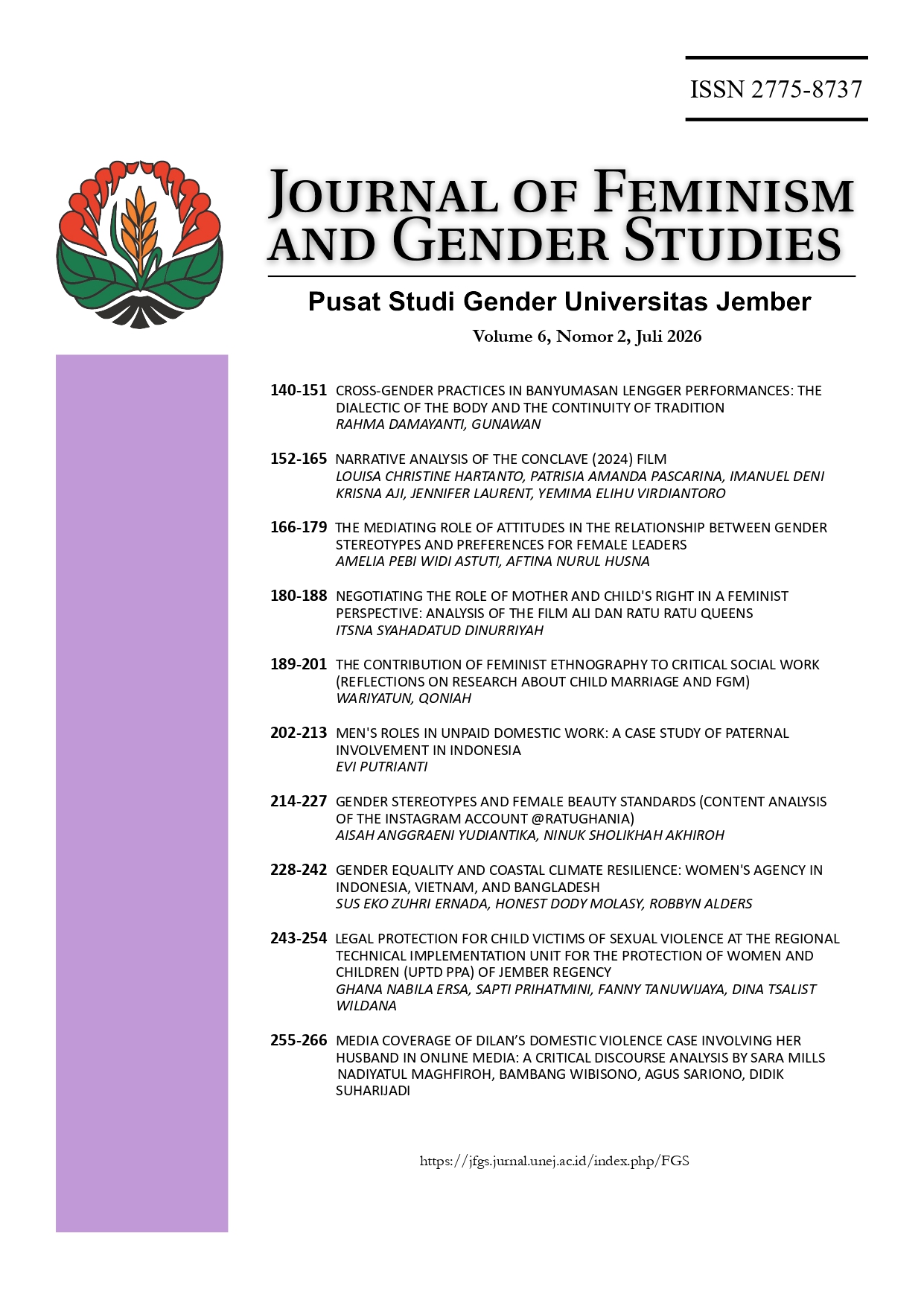
The Contribution of Feminist Ethnography to Critical Social Work
Reflections on Research about Child Marriage and FGM
DOI:
https://doi.org/10.19184/jfgs.v6i2.53727Keywords:
ethnography, anthropologi, feminist, social work, social injusticeAbstract
Ethnography is well-known as a research method that is usually applied in anthropology. In its development, social science and humanities researchers have adopted ethnography as their research method. The development program applied ethnography for baseline, monitoring, and evaluation methods. It is applied especially for examining social problems rooted in the socio-cultural context. Translating cultural reflection on field work is a power of ethnography. Ethnography provides a means to describe events, socio-cultural phenomena, and social issues. Those phenomena are analyzed and interpreted from the perspective of the subject of research. This paper argues that ethnography contributes to critical social work studies by translating the cultural meanings behind child marriage and female genital mutilation (FGM) phenomena. It also argues that a feminist approach combined with ethnography can minimize research dilemmas, capture injustice, and unravel the intersectionality inherent in social work. Research on child marriage and FGM requires not only ethnography but also a feminist approach. A feminist approach can explore the power relations between men and women in the issues of FGM and child marriage. Feminist ethnography's methods can uncover power relations and injustices in society. This paper utilizes a critical reflection method for data collection. Applying a critical reflection based on the researcher's experience in research on child marriage and FGM, it is found that ethnography can translate the cultural meanings behind child marriage and FGM. Further findings indicate that a feminist approach combined with ethnography can minimize research dilemmas, capture injustice, and unravel the intersectionality inherent in social work. This study employs critical reflection for data collection. The data analyzed in this paper is the author’s personal experience conducting two research projects in East Nusa Tenggara (NTT) in 2019, and in West Nusa Tenggara (NTB) and East Java in 2025.
Downloads
References
Abdullah, I. (2014). Solusi Antropologi Untuk Indonesia ; Kearifan Lokal, Pendidikan dan Kebijakan Berwawasan Budaya. In Teori, Etnografi dan Refleksi. PINTAL.
Abdullah, I. (2015). Realitas Politik, Deteritorialisasi Ssial, dan Redefinisi Penelitian Budaya: Aceh sebagai Field of Study. In Kontruksi dan Reproduksi Kebudayaan (V, pp. 121–137).
Agar, M. H. (1996). The Professional Stranger: An Informal Introduction to Ethnography (2nd ed) (2nd ed.). Academic Press.
Balestrery, J. E. (2016). Social Work Education without Walls: Ethnography as a Lens for Transformative Learning. Social Work Education, 35(6), 615–631. https://doi.org/10.1080/02615479.2016.1151490
Bavel, H. V. (2022). Education, Class, and Female Genital Cutting among the Samburu of the Northern Kenya: Challeninging the Reproduction of the “Iqnorant Pastoralist” Narrative in Anticutting Campaign. Journals.Sagepub.Com/Home/Vaw, 15–16, 3742–3761. https://doi.org/10.1177/10778012221079376
Baynesagn, A. H., & Maru Wubie, T. (2025). Locked in Tradition: Upholding Child Marriage Practice in East Gojjam Zone, Ethiopian. Families in Society: The Journal of Contemporary Social Services, 106(1), 102–115. https://doi.org/10.1177/10443894241233330
Bernard, H. R. (2006). Research Methods In Antropologi, Qualitative and Quantitative Approaches (4th ed). AltaMira Press.
Bihonegn, A. A., Hailu, K. H., & Shiferaw, A. M. (2025). Understanding the Lived Experiences of Women Underwent Female Genital Mutilation (FGM) in Bichena Town, North-Western Ethiopia. Journal of Social ServiceResearch, 1–13. https://doi.org/10.1080/01488376.2025.2451941
Bozorgi-Saran, S., & Khodabakhshi-Koolaee, A. (2023). Child bride, a story that never ends: A look at experiences of Iranian women. International Social Work, 66(5), 1497–1512. https://doi.org/10.1177/00208728211066830
Clifford, J., & Marcus, G. (1986). Writing Culture: The Poetics and Politics of Ethnography. University of California Press.
Creswell, J. W. (2015). Penelitian Kualitatif dan Desain Riset: Memilih Di Antara Lima Pendekatan (3rd ed.). Pustaka Pelajar.
Doucet, M.-H., Delamou, A., Manet, H., & Groleau, D. (2022). Beyond the Sociocultural Rhetoric: Female Genital Mutilation, Cultural Values and the Symbolic Capital (Honor) of Women and Their Family in Conakry, Guinea—A Focused Ethnography Among “Positive Deviants.” Sexuality & Culture, 26(5), 1858–1884. https://doi.org/10.1007/s12119-022- 09975-5
Gamble, S. (2004). Feminism and Post Feminism. Routledge.
Giddens, A. (2016). Teori Strukturasi: Dasar-Dasar Pembentukan Struktur Sosial Masyarakat (II). Pustaka Pelajar.
Horii, H. (2020). Child Marriage as a ‘Solution’ to Modern Youth in Bali. Progress in Development Studies, 20(4), 282–295. https://doi.org/10.1177/1464993420977793
Ida, R., & Saud, M. (2020). Female Circumsision and The Construction of Female Sexuality: A Study on Maduranese in Indonesia. Sexuality and Culture, 24(565), 1987–2006. https://doi.org/10.1007/S12119-020-09732-6
ISFW dan IASSW. (2014), Global Definition of the Social Work Profession, https://ifsw.org/what-is-social-work/global -defenition-of-social-work
Marcus, G. E. (1991). Requirements for Ethnographies of Late-20th-Century Modernity Worldwide. In Ethnography through Thick and Thin (pp. 57–78). Princenton University Press.
Miller, T., Smith, K., & Lockwood, K. (2017). Doing Narrative Research?Thingking Through The Narative Process. In Feminis Narrative: Research Opportunities and Challenge (pp. 39–60). Palgrave Macmillan.
Morrow, F. (2024). Invisible authors: An ethnography of the social life of social work assessment. Journal of Social Work Practice, 38(4), 373–386. https://doi.org/10.1080/02650533.2024.2402811
Mubarok, Achmad Sofiyul, Muhammad Ainun Rofiq, M. Khoirul Hadi al Asyari. (2026). Tradisi Pernikahan Colong dalam Masyarakat Osing : Tinjauan Antropologi Hukum terhadap Teks Keagamaan Islam dan Praktik Kultural di Banyuwangi. Journal of Feminism and Gender Studies, 6(1), 127-139. https;//jfgs.jurnal.unej.ac.id/index.php/FGS
Mulinari, D., & Sandell, K. (2009). A Feminis Re-reading of Theories of Late Modernity: Beck, Giddens and the Location of Gender. Critical Sociology, 35(4), 493–507. https://doi.org/10.1177/0896920509103980
Naples, N. A. (2003). Feminism and method: Ethnography, discourse analysis, and activist research. Routledge.
Neema, S., Muhumuza, C., Nakigudde, R., Uldbjerg, C. S., & Muhwezi, E. (2025). “Trading daughters for livestock.”
Noerdin, E. (with Women Research Institute). (2005). Politik identitas perempuan Aceh (Cet. 1). Women Research Institute.
Nordstedt, M., & Gustafsson, K. (2022). From Experience to Text: Issues of Representation, Disclosure, and Understanding in Ethnographic Social Work Research. Ethics and Social Welfare, 16(3), 274–289. https://doi.org/10.1080/17496535.2021.2021265
Powell, D. (2022). Critical Etnography in Schools: Reflections on Power, Positionality, and Privelege. 35(1), 18–31. https://doi.org/10.1080/09518398.2021.1888160
Putra, Heddy Shri Ahimsa (ed). (2014). Teori, Ethnografi dan Refleksi. Pintal.
Rivers, N. (2017). Postfeminism and The Arrival of the Fourth wave. Palgrave Macmillan.
Sicora, A. (2017). Reflective Practice, Risk and Mistakes in Social Work. Journal of Social Work Practice, 31(4), 491–502. https://doi.org/10.1080/02650533.2017.1394823
Spradley, J. P. (1979). The ethnographic interview. Holt, Rinehart and Winston. Spradley, J. P. (2007). Metode Etnografi (Kedua). Tiara Wacana.
Suryakusuma, J. (2011). Ibuism Negara: Konstruksi Sosial Keperempuanan Orde Baru (1st ed.). Komunitas Bambu.
Tong, R. P., & Botts, T. F. (2018). A Feminis Thought: A More Comprehensive Inntroduction (Fifth). Routledge Taylor&Francis Group.
Undang-Undang Perlindungan Anak, Pub. L. No. 35 (2014).
Wariyatun, W. (2021b). Refleksi Penelitian Ethonography Feminis dalam Masa Pandemic. In Prosiding International Conference on Indonesia Culture The Resilience of The Cultural Ecosyystem through the Pandemic (pp. 319–328). Kemenristek Dikbud - FIB UGM - Koalisi Seni.
Warren, C. A. B., Hackney, J. K., & Warren, C. A. B. (2000). Gender issues in ethnography (2nd ed). Sage Publications.
Downloads
Published
Issue
Section
License
Copyright (c) 2026 Wariyatun, Qoniah

This work is licensed under a Creative Commons Attribution-ShareAlike 4.0 International License.