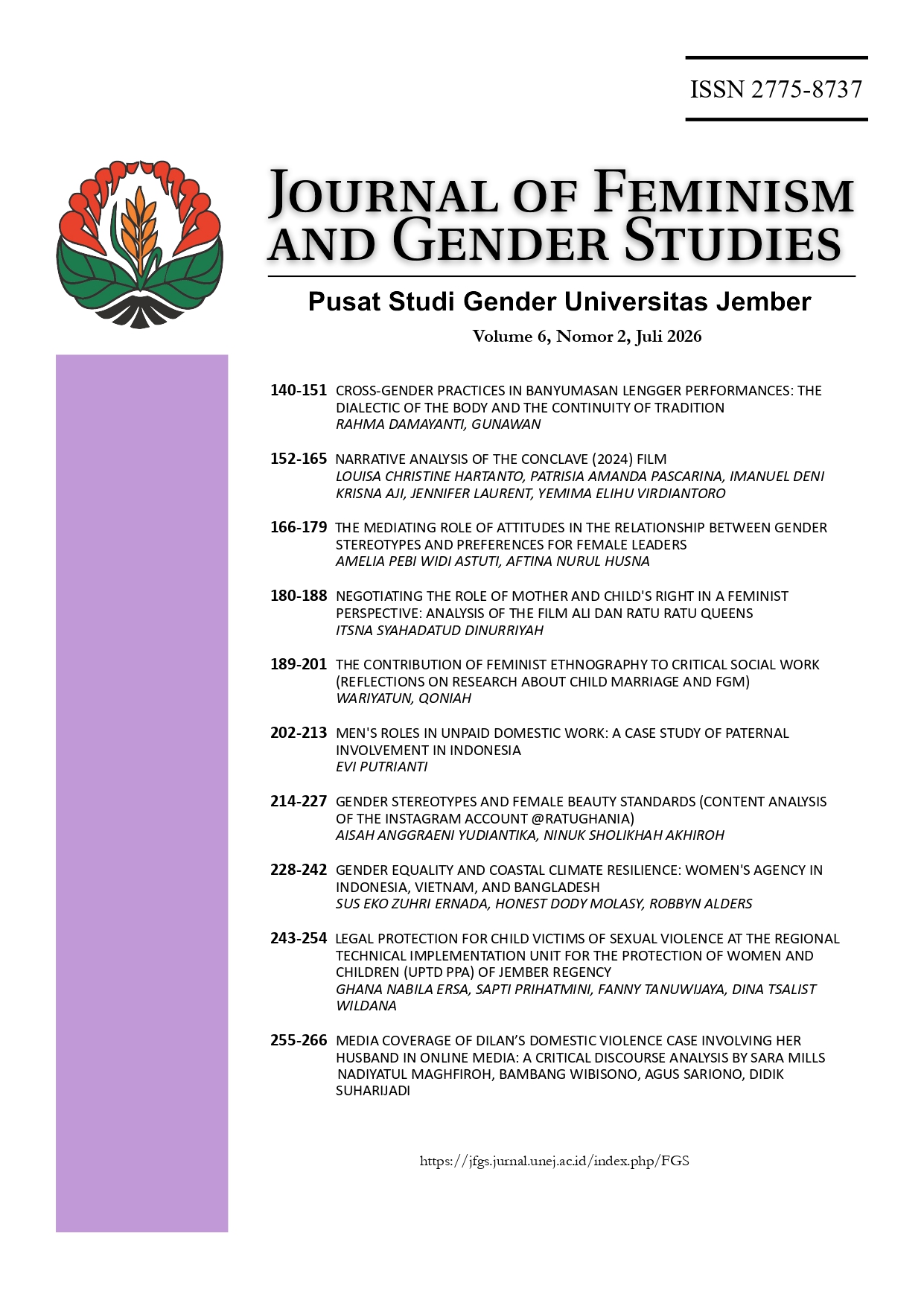
The Mediating Role of Attitudes in the Relationship Between Gender Stereotypes and Preferences for Female Leaders
DOI:
https://doi.org/10.19184/jfgs.v6i2.53733Keywords:
Gender Equality, Female Leadership, Gender Stereotypes, Gender BiasAbstract
Gender stereotypes contribute to the low representation of women in leadership and influence individual preferences in selecting female leaders. These stereotypes, shaped by social constructs, can marginalize women’s roles and reduce trust in female leadership. This study aims to examine the effect of gender stereotypes on the preference for female leaders, with attitudes toward female leadership as a mediating variable. The research was conducted on 152 civil servants in the Semarang City Government using a convenience sampling technique. Data were collected using three instruments: a gender stereotype scale, the Attitudes Toward Women in Leadership scale, and a vignette-based and a vignette-based survey to measure participants’ preference for female leaders. Mediation analysis revealed that female gender stereotypes indirectly influence the preference for female leaders through attitudes toward female leadership, indicating full mediation (β = -0.137, p < 0.05). These findings highlight the importance of fostering more positive attitudes toward female leadership to enhance trust and promote a more equitable and inclusive work environment.
Downloads
References
Abbas, N. (2020). Dampak feminisme pada perempuan. Al-Wardah: Jurnal Kajian Perempuan, Gender dan Agama, 14(2), 187–198.
Ajzen, I. (1991). The theory of planned behavior. Organizational Behavior and Human Decision Processes, 50(2), 179–211.
Alisa, J., Laela, E., & Nurjanah, R. (2024). Gender stereotypes from a management perspective: A literature review. Journal of Feminism and Gender Studies, 4(2). DOI: https://doi.org/10.19184/jfgs.v4i2.45136
Azzahra, G. A. (2024). Pengembangan stereotip gender terhadap persepsi karyawan pada manajer perempuan. Konstruksi Sosial : Jurnal Penelitian Ilmu Sosial, 3(4), 111–121. https://doi.org/10.56393/konstruksisosial.v1i12.1375
Badan Pusat Statistik. (2024). Persentase tenaga kerja formal menurut jenis kelamin. https://www.bps.go.id/id/statistics-table/2/MTE3MCMy/persentase-tenaga-kerja-formal-menurut-jenis-kelamin.html
Baiduri, I., Hasanah, N., Maulana, F., & Anshori, M. I. (2023). Gender dan kepemimpinan: Sebuah kajian literatur. Jurnal Ilmu Manajemen, Ekonomi dan Kewirausahaan, 3(2), 179–204. DOI: https://doi.org/10.55606/jimek.v3i2.1782
Braun, S., Stegmann, S., Hernandez Bark, A. S., Junker, N. M., & Van Dick, R. (2017). Think manager—think male, think follower—think female: Gender bias in implicit followership theories. Journal of Applied Social Psychology, 47(7), 377–388. DOI: https://doi.org/10.1111/jasp.12445
Eagly, A. H., & Karau, S. J. (2002). Role congruity theory of prejudice toward female leaders. Psychological Review, 109(3), 573–598. DOI: https://doi.org/10.1037/0033-295X.109.3.573
Firdausia, S. (2018). Hubungan antara stereotip gender dan efikasi diri dengan glass ceiling pada aparatur sipil negara perempuan di BAPPEDA Provinsi Jawa Tengah [Undergraduate Thesis (Skripsi S1)]. Universitas Sebelas Maret.
Firin, M. (2004). Pengaruh simbol lelaki, perempuan, dan toga serta pemaknaannya terhadap sikap stereotipe gender [Master’s Thesis]. Universitas Gadjah Mada.
Fishbein, M., & Ajzen, I. (1975). Belief, attitude, intention, and behavior: An introduction to theory and research. Addison-Wesley.
Fitriana, A., & Cenni, C. (2021). Perempuan dan kepemimpinan. 1, 247–256. DOI: https://doi.org/10.33363/sn.v0i1.65
Gawronski, B., & Strack, F. (2012). Cognitive consistency: A fundamental principle in social cognition. Guilford Press.
Gazali, M. R. A., Sultan, L., & Arsyad, A. (2026). Konsep pemikiran hukum Islam tentang kepemimpinan gender. LexIslamica: A Multidisciplinary Approach to Islamic Law and Its Contemporary Applications, 2(6), 18–26.
Hayes, A. F. (2018). Introduction to mediation, moderation, and conditional process analysis: A regression-based approach (2nd ed.). The Guilford Press.
Hidayah, S. N., & Munastiwi, E. (2019). Pemimpin akademik atau manajerial? Aspirasi, harapan dan tantangan perempuan untuk menjadi pemimpin di lembaga pendidikan tinggi islam. PALASTREN Jurnal Studi Gender, 12(2), 455. DOI: https://doi.org/10.21043/palastren.v12i2.5628
Hidayat, R. (2023). Analisa penerapan sistem merit di Pemerintah Kota Mataram (studi pengisian jabatan pimpinan tinggi pratama tahun 2022). Jurnal Ilmiah Tata Sejuta STIA Mataram, 9(2), 388–407. DOI: https://doi.org/10.32666/tatasejuta.v9i2.603
Judiasih, S. D. (2022). Implementasi kesetaraan gender dalam beberapa aspek kehidupan bermasyarakat di Indonesia. ACTA DIURNAL Jurnal Ilmu Hukum Kenotariatan, 5, 284–302.
Kamil, N., Saputri, I. D., Zahrah, F., & Mufida, A. Y. (2024). Sibling rivalry: Timbulnya kecemburuan sosial yang disebabkan oleh perbedaan gender atau rentang usia kelahiran (kasus pada usia 3–6 tahun). Az-Zahra: Journal of Gender and Family Studies, 4(2), 103–113. DOI: https://doi.org/10.15575/azzahra.v4i2.29722
Liao, W., & Luo, L. (2021). Gender, education, and attitudes toward women’s leadership in three East Asian countries: An intersectional and multilevel approach. Societies, 11(3), 103. DOI: https://doi.org/10.3390/soc11030103
Pane, O. O., Sihombing, S., Simbolon, D., Zalukhu, D., & Lumbantobing, R. (2024). Kesetaraan gender. Kultura: Jurnal Ilmu Hukum, Sosial, Humaniora, 2(6), 298–304.
Park, S., & Liang, J. (2021). A comparative study of gender representation and social outcomes: The effect of political and bureaucratic representation. Public Administration Review, 81(2), 321–332. DOI: https://doi.org/10.1111/puar.13092
Prastio, L. O., Abdillah, A., Nurlia, E., & Tati, T. (2021). Kepemimpinan perempuan di pemerintah daerah: Kajian kepemimpinan perempuan Wali Kota Tangerang Selatan. Journal of Governance and Local Politics (JGLP), 3(2), 103–114. DOI: https://doi.org/10.47650/jglp.v3i2.261
Priatiningsih, S. (2018). Kepemimpinan wanita sebagai kepala sekolah studi di SD Negeri Kecamatan Balung Kabupaten Jember. Journal of Administration and Educational Management (Alignment), 1(1).
Ramseook-Munhurrun, P., Naidoo, P., & Armoogum, S. (2025). Navigating the challenges of female leadership in the information and communication technology and engineering sectors. Journal of Business and Socio-Economic Development, 5(1), 55–70. DOI: https://doi.org/10.1108/JBSED-03-2023-0014
Rohim, A. Z., Rohmawati, A., Fitriyah, A. Z., Lillah, F. T., Putra, R. S., & Fatimah, N. (2024). Kepemimpinan berbasis gender: Systematic literature view. Jurnal Ekonomi, Pendidikan dan Pengabdian Masyarakat, 1(3), 86–92.
Rohmany, S. M., Alfirdaus, L. K., & Fitriyah, F. (2023). Kebijakan perlindungan pekerja perempuan dari perspektif keadilan gender dan hak-hak pekerja perempuan (studi kasus pekerja perempuan PT X di Kabupaten Jepara). Journal of Politic and Government Studies, 12(4), 100–119.
Rokhim, I. M., & Noorrizki, R. D. (2023). Stereotip gender pada wanita karir di tempat kerja. Flourishing Journal, 2(6), 415–421. DOI: https://doi.org/10.17977/um070v2i62022p415-421
Sari, N. R., Gunawan, A., & Rahmawati, F. (2025). Analisis dampak ketimpangan gender terhadap partisipasi perempuan di dunia kerja. Sahmiyya: Jurnal Ekonomi dan Bisnis, 313–321.
Schiffman, L., & Kanuk, L. L. (2007). Perilaku konsumen (Edisi ke-7). Indeks.
Septiana, A. N., & Haryanti, R. H. (2023). Glass ceiling pada pekerja Perempuan: Studi literatur. Jurnal Ilmu Sosial dan Humaniora, 12(1), 168–177. DOI: https://doi.org/10.23887/jish.v12i1.58384
Siregar, E. S. M., & Wardi, Y. (2023). Pengaruh gender dan gaya kepemimpinan terhadap kinerja organisasi. Jurnal Education and Development, 11(3), 2223–2229.
Sitoresmi, R., & Herdiana, I. (2022). Hubungan antara gender role attitudes dan fear of success terhadap career salience pada perempuan dewasa awal yang bekerja. Jurnal Syntax Admiration, 3(7), 924–938. DOI: https://doi.org/10.46799/jsa.v3i7.461
Spence, J. T., & Helmreich, R. (1972). The attitudes toward women scale: An objective instrument to measure attitudes toward the rights and roles of women in contemporary society. JSAS Catalog of Selected Documents in Psychology, 2, 66–67.
Sriwijayanti, S., Widyarini, N., & Linsiyah, R. W. (2023). Gambaran stereotype gender di wilayah Kabupaten Jember. Jurnal Psikologi, 1(2), 11. DOI: https://doi.org/10.47134/pjp.v1i2.2002
Steffens, M. C., Viladot, M. A., & Scheifele, C. (2019). Male majority, female majority, or gender diversity in organizations: How do proportions affect gender stereotyping and women leaders’ well-being? Frontiers in Psychology, 10, 1037. DOI: https://doi.org/10.3389/fpsyg.2019.01037
Suyanto, A. W., & Astuti, S. P. (2022). Stereotip perempuan dalam bahasa indonesia dalam ranah rumah tangga. SEMIOTIKA: Jurnal Ilmu Sastra Dan Linguistik, 14(1), 79–90. DOI: https://doi.org/10.19184/semiotika.v14i1.30110
Wattimena, A. N., & Hutabarat, G. F. I. (2021). Pengaruh femininitas perempuan dalam negosiasi konflik. Journal of International Relations (JoS), 1(1), 32–42.
Wiasti, N. M. (2017). Mencermati permasalahan gender dan pengarusutamaan gender (PUG). Sunari Penjor: Journal of Anthropology, 1(1), 29–42.
Widiyaningrum, W. Y. (2020). Partisipasi politik kader perempuan dalam bidang politik: Sebuah kajian teoritis. Jurnal JISIPOL Ilmu Pemerintahan Universitas Bale Bandung, 4(2), 126–142.
Downloads
Published
Issue
Section
License
Copyright (c) 2026 Amelia Pebi Widi Astuti, Aftina Nurul Husna

This work is licensed under a Creative Commons Attribution-ShareAlike 4.0 International License.