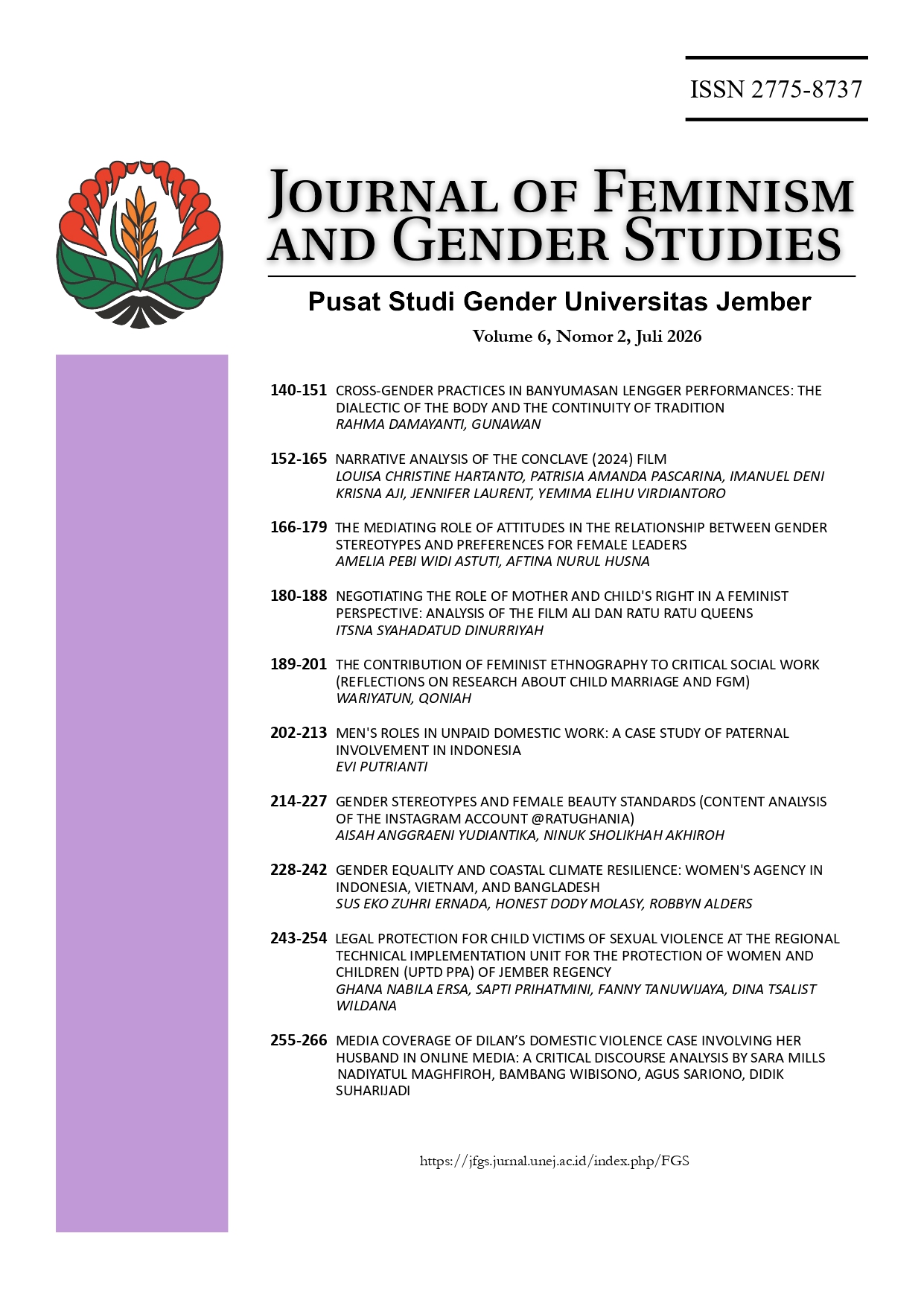
Gender Equality and Coastal Climate Resilience: Women's Agency in Indonesia, Vietnam, and Bangladesh
DOI:
https://doi.org/10.19184/jfgs.v6i2.53772Keywords:
Gender Equality, Women's Agency, Coastal Climate Resilience, Feminist Political Ecology, Climate GovernanceAbstract
Coastal communities in Indonesia, Vietnam, and Bangladesh are increasingly exposed to climate-related hazards that threaten livelihoods, ecosystems, and social well-being. Although previous studies have extensively documented women's vulnerability to climate change, comparatively little attention has been paid to the mechanisms through which gender equality strengthens coastal climate resilience across different governance contexts. This study examines the relationship between gender equality and coastal climate resilience through a qualitative comparative analysis of Indonesia, Vietnam, and Bangladesh. The analysis integrates primary evidence from Focus Group Discussions (FGDs) conducted in Indonesia with secondary evidence from Vietnam and Bangladesh, complemented by policy documents and scholarly literature. Data were analysed using thematic analysis. The findings demonstrate that women make substantial contributions to climate adaptation through livelihood diversification, local ecological knowledge, environmental stewardship, collective action, and disaster preparedness. However, these contributions remain constrained by unequal access to productive resources, limited participation in decision-making, and persistent socio-cultural and institutional barriers. The comparative analysis further demonstrates that gender equality strengthens adaptive capacity by enabling women's agency, while inclusive governance determines the extent to which this agency can be translated into long-term coastal climate resilience. The study advances an integrated conceptual framework positioning women's agency as the central mechanism linking gender equality, adaptive capacity, and coastal climate resilience across diverse institutional contexts. These findings contribute to Feminist Political Ecology by demonstrating that resilient coastal communities are shaped not only by technological adaptation but also by inclusive governance that recognises women's knowledge, participation, and leadership.
Downloads
References
Braun, V., & Clarke, V. (2006). Using thematic analysis in psychology. Qualitative Research in Psychology, 3(2), 77–101. https://doi.org/10.1191/1478088706qp063oa
Creswell, J. W. , & Poth, C. N. (2018). Qualitative Inquiry and Research Design: Choosing Among Five Approaches. Sage Publications.
Denzin, N. K. (1978). The Research Act: A Theoretical Introduction to Sociological Methods (2nd ed.). McGraw-Hill.
Dewi, K. H., Sari, D. P., & Latifa, A. (2022). Sustainability of Climate Change Issues in Indonesia: The Voices of Women’s NGOs. Iop Conference Series Earth and Environmental Science, 1105(1), 012005. https://doi.org/10.1088/1755-1315/1105/1/012005
Forty-Ninth Session of the IPCC: Report From the IPCC Task Group on Gender. (2019). www.ipcc.ch
Kabir, R., Khan, H. T. A., Ball, E., & Caldwell, K. (2016). Climate Change Impact: The Experience of the Coastal Areas of Bangladesh Affected by Cyclones Sidr and Aila. Journal of Environmental and Public Health, 2016, 1–9. https://doi.org/10.1155/2016/9654753
Lincoln, Y. S., & Guba, E. G. (1985). Naturalistic Inquiry. Sage Publications.
Malik, I., Abdillah, *, Rusnaedy, Z., & Khaerah, N. (2021). Coastal Women’s Resilience Strategy Against Climate Change Vulnerability in Makassar, Indonesia. E3s Web of Conferences, 277, 01003. https://doi.org/10.1051/e3sconf/202127701003
Morgan, D. L. (1997). Focus Groups as Qualitative Research (2nd ed., Vol. 16). Sage Publications.
Mori, N., & Shimura, T. (2022). Tropical Cyclone-Induced Coastal Sea Level Projection and the Adaptation to a Changing Climate. Cambridge Prisms Coastal Futures, 1. https://doi.org/10.1017/cft.2022.6
Nightingale, A. J. (2006). The Nature of Gender: Work, Gender, and Environment. Environment and Planning D Society and Space. https://doi.org/10.1068/d01k
Ojeda, D., Nirmal, P., Rocheleau, D., & Emel, J. (2022). Feminist Ecologies. Annual Review of Environment and Resources, 47(1), 149–171. https://doi.org/10.1146/annurev-environ-112320-092246
Rocheleau, D. E., Thomas-Slayter, B., & Wangari, E. (Eds.). (1996). Feminist Political Ecology: Global Issues and Local Experiences. Routledge.
Roy, N. C., Chowdhury, M. A., & Akther, K. R. (2021). Enhancement of Climate-Resilient Livelihoods in Coastal Agricultural Communities With an Emphasis on Women. Archives of Agriculture and Environmental Science, 6(4), 441–452. https://doi.org/10.26832/24566632.2021.060405
Shanthi, B., Mahalakshimi, P., & Chandrasekaran, V. S. (2017). Assessment of Challenges Faced by the Coastal Women Due to the Impact of Climatic Change in Selected Coastal Districts of Tamil Nadu, India. Indian Journal of Fisheries. https://doi.org/10.21077/ijf.2017.64.special-issue.76247-21
Torre‐Castro, M. d. l., Lindström, L., Jiddawi, N., Pike, F., & Max, A. (2022). Women and Adaptive Capacity to Climate Change in East African Seascapes – Zanzibar as an Example. Frontiers in Marine Science, 9. https://doi.org/10.3389/fmars.2022.931883
UN Women. (2021). Gender and Climate Change: Empowering Women for Climate-Resilient Societies. https://asiapacific.unwomen.org/en/focus-areas/humanitarian-action-and-disaster-risk-reduction/gender-and-climate-change
Yin, R. K. (2018). Case Study Research and Applications: Design and Methods (6th ed.). SAGE Publications.
Zvobgo, L., Johnston, P., Williams, P. A., Trisos, C. H., & Simpson, N. P. (2022). The Role of Indigenous Knowledge and Local Knowledge in Water Sector Adaptation to Climate Change in Africa: A Structured Assessment. Sustainability Science, 17(5), 2077–2092. https://doi.org/10.1007/s11625-022-01118-x
Downloads
Published
Issue
Section
License
Copyright (c) 2026 Sus Eko Zuhri Ernada, Honest Dody Molasy, Robbyn Alders

This work is licensed under a Creative Commons Attribution-ShareAlike 4.0 International License.